Stanford GSB mock interview
A twenty-minute spoken mock interview for Stanford GSB, and a written report afterwards on what landed and what did not.
How Stanford GSB interviews
Stanford GSB is one of the schools that run behavioral interviews. That page compares the schools that do and says how to prepare.
- Required before any offer of admission.
- A structured behavioral interview about what you have done and how, with a trained alum or a member of the admissions team.
- Remote or in person; you cannot request an interview on campus.
From Stanford GSB’s own site: Stanford GSB: interviews
Applicants report, though Stanford GSB does not say so itself:
- The interviewer has only your résumé, and it runs 45 to 60 minutes, with time at the end for your questions.
A guide for this interview: How to Answer “What Kinds of People Frustrate You?” in an MBA Interview.
Checked 24 September 2026, for the 2026–27 cycle. Formats change from one year to the next; confirm the details in your invitation.
Stanford's interview is blind (the alum interviewing you has your resume and nothing else), and it runs 45 to 60 minutes: mostly behavioral questions about what you have actually done, going deep on two or three stories rather than across the whole resume, then time at the end for your own questions about Stanford. Dean practices that first part, from your CV, for twenty minutes. Nothing here stands in for the questions you get to ask them.
Start your Stanford GSB interviewSee a sample report ↗
How it works
- Give us your CV, or just type it, and pick your school. Dean asks one consultant's questions, about Stanford GSB.
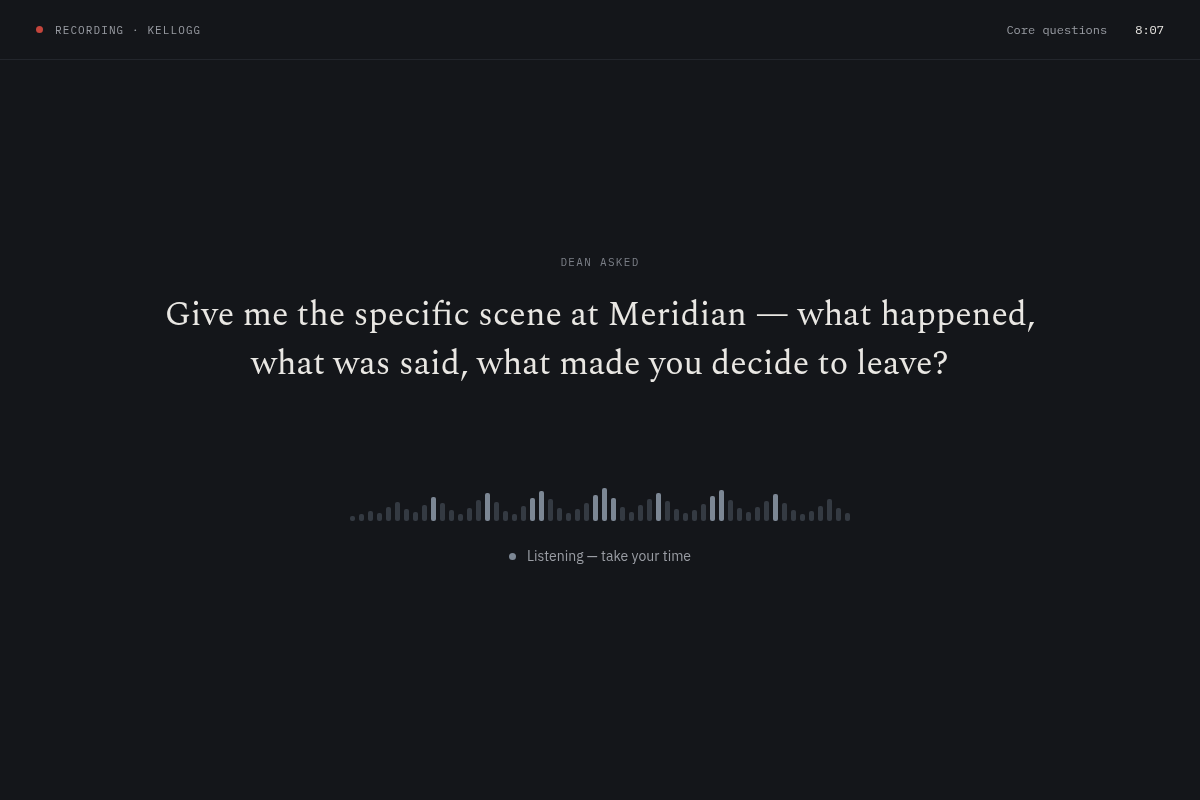
- Talk for twenty minutes. No push-to-talk and no script on your side: the interviewer asks, listens, and follows up on what you actually said, which means it will not go exactly as you rehearsed it.
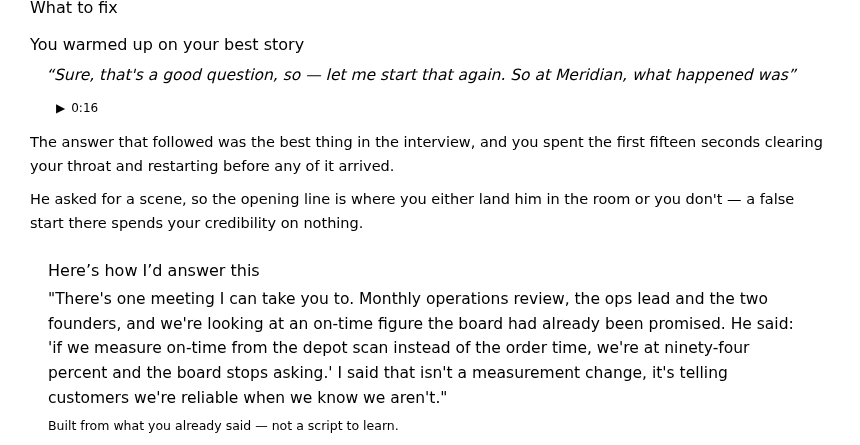
- Read the report. Scored against what an experienced interviewer listens for, quoting what you said, with the things to fix first.
Why practice out loud
Reading the questions is not answering them. Most people find out how long their answer actually runs, and how much of it is abstract, the first time they say it to someone who follows up. That is the part a Stanford GSB interview tests, and it is the part a list of questions cannot rehearse.
What it costs
$60 for 3 interviews, or $25 for a single one, charged once in USD. Not a subscription: nothing renews, and there is nothing to cancel. Unused interviews can be refunded within 30 days, and an interview that fails on our side is refunded without you having to ask. The refund policy is the full version and it is short.
Who it is from
Dean runs the interview a Harvard MBA and admissions consultant has spent years giving: the same questions, in the same order, with the same follow-ups when an answer stays abstract. It is software: an interviewer and a written report on your own schedule, not a conversation with a human consultant. How this is worked out.